What Patients Live

The signals exist.
The system does not consistently see them.

This is what rare disease patients carry during clinical trial participation. It is not visible in any endpoint. It is not counted in any economic model. It is documented only in the testimonies patients give to the FDA when asked directly, in qualitative studies that rarely cross into trial protocols, and in the memories of the caregivers and clinicians who happen to hear it.

The Before and After

One patient. One moment.
Two pictures.

Below is a composite patient case drawn from multiple QIS Session 1 interviews. The "Without QIS" panel reflects what the trial captures. The "With QIS" panel reflects what QIS surfaces. Same patient. Same month. Different conclusion.

Without QIS

What the clinical record shows at Month 3

FVC 69% predicted. Mild decline noted.

6MWT 318 meters. Stable.

Patient reports oxygen use as prescribed.

Clinician note: continue current plan.

Month 10: appointment missed. No response to voicemail. Patient lost.

With QIS

What the qualitative record shows at Month 3

Oxygen concentrator has not left the house since January. Identity barrier, not forgetfulness.

Caregiver rescheduled his own cardiology appointment to drive her 38 miles. His health now deferred.

Patient carries groceries in two trips and stops on the front steps.

Book club. Church. She stopped attending both.

Human Gate Triggered. Care coordinator outreach recommended within 72 hours.

Month 10: appointment kept. Patient retained.

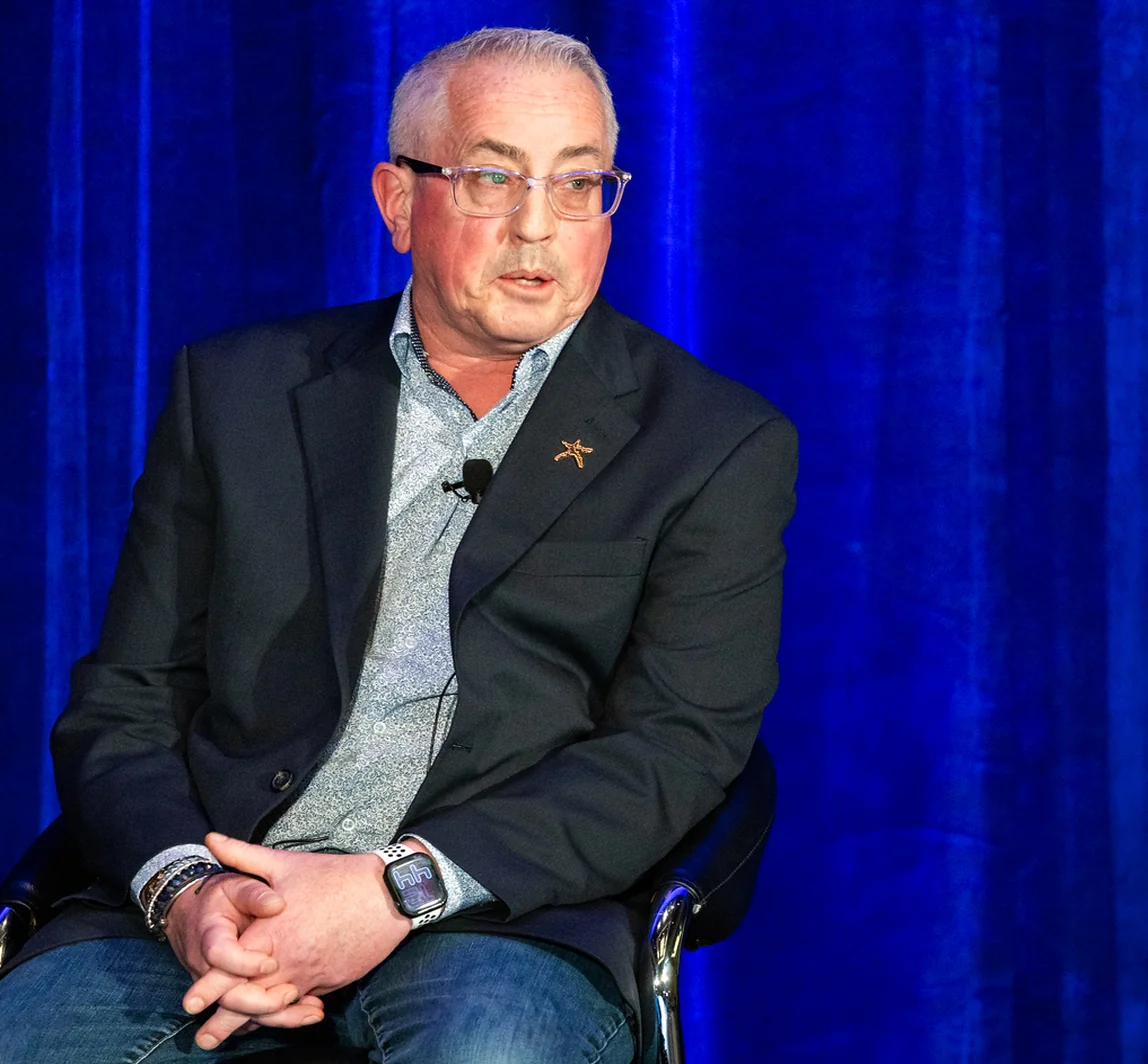
Tom Tully, Patient Adviser
A Patient Adviser Speaks

“The challenge will be for HCPs to focus more on patient outcomes and less on volume of patients seen.”

Tom Tully

Patient Adviser, Qualividence · Partner, Three Lakes 12-20 · Familial PF survivor and lung transplant recipient

Read Tom's full story →

What the clinical record
was never built to hold.

These are anonymized excerpts from six QIS Session 1 interviews with people living with pulmonary fibrosis and interstitial lung disease, across very different stages of diagnosis and survival. They are not included here as illustrations. They are part of the record.

Each quote names something the formal clinical system did not know how to hold in the moment it mattered. Delay. Denial. Family pattern. Identity loss. Quiet adaptation. Deferred care. None of these are side notes to the disease experience. They shape what happens next.

QIS treats these voices with the same seriousness as any endpoint. They are true records of lived experience. That is what qualifies them.

I had so many tests and so many doctors tell me I'm fine, that I started with the mindset of I'm fine. Don't even think about it. I basically lived in a state of denial.

A PF Patient
QIS Session 1 · The years before diagnosis

My primary care doctor wrote look for cancer on the script for chest X-rays. I didn't read it for two or three weeks. I just carried it in my bag.

A Long-Survivorship Patient
QIS Session 1 · On a written clinical signal that nearly went unread

Actually, nobody did. I mean, my husband might have said something, but you know how we don't listen to our husbands.

An ILD Patient
QIS Session 1 · Answering "did anyone notice before you did?"

I really hadn't connected the dots until now, but I definitely started having signs of depression and anxiety in that period, and I didn't know why.

A PF Patient
QIS Session 1 · What preceded the clinical picture

I blamed it on the flights. I'd leave for work, and my husband would say have fun, and then I'd think, I've got to walk to Amsterdam.

An IPF Patient
QIS Session 1 · How the slow-down was explained away

I was in denial. Even when I got diagnosed, I was in denial, even when they told me I had IPF and I was put on oxygen.

An IPF Patient
QIS Session 1 · The persistence of denial under clinical care
Cross-Patient Finding

The signal existed in writing. It never reached the moment of action.

Observed across three of six Session 1 interviews

In three of the six Session 1 interviews, the clinical system produced a documented suspicion. A written script. An ER report. A referral note. In each case the signal did not reach the person who needed to act on it. One patient carried a script reading "look for cancer" in her bag for three weeks without reading it. Another had an ER report naming idiopathic pulmonary fibrosis that went unacknowledged for two years. A third was treated for asthma while the familial history sat in the chart unexamined.

Three cases. Three different mechanisms of transmission failure. One shared structural pattern. This is the kind of finding QIS was built to surface.
The Landscape

The qualitative landscape
is not empty. It is fragmented.

The FDA's Patient-Focused Drug Development initiative has operated since 2012. Disease-specific patient-reported outcomes exist and are used systematically in cystic fibrosis and Duchenne muscular dystrophy pivotal trials. Voice of the Patient reports are cited in drug filings. A 2024 qualitative analysis of FDA patient engagement sessions across twenty-nine rare diseases documented what patients name as the worst aspects of their conditions, including mental health impact. The frameworks exist.

The adoption does not. Published analyses of orphan drug labeling show that only seventeen percent of orphan drug labels contain a patient-reported outcome measure. Less than half of pivotal orphan trials use PROs as primary or secondary endpoints. Over the past two years, I have asked top doctors, pharma medical affairs executives, federal agency staff, and rare disease researchers which methodology they use to integrate qualitative patient intelligence into trial design. Not one cited a consistent framework. Not one named a tool they rely on.

The infrastructure does not exist as practice. It exists as guidance that has not been built into execution.

The Cost of the Fragmentation

Carried by patients, by pharma,
and by the ecosystem that serves them.

Ninety percent of drugs that enter clinical trials fail to reach FDA approval. That figure is industry canonical, documented in the 2021 BIO Industry Analysis covering 9,704 clinical development programs and confirmed by MIT research covering 21,143 compounds. Total development cost per approved drug, including the cost of failures, is estimated at two point six billion dollars in 2013 dollars per the Tufts Center for the Study of Drug Development. Late-stage trial failures alone can exceed one billion dollars each.

Patient attrition compounds the loss. Average late-phase dropout rose from fifteen point three percent in 2012 to nineteen point one percent in 2019, a twenty-five percent increase over seven years. In CNS trials, dropout reaches twenty-five point nine percent. Rare disease trials face additional structural barriers before patients even enroll. Eighty-one percent of patients screened for rare disease trials are ineligible. Twenty-five to thirty-two percent of rare disease trials are terminated due to low accrual.

The financial cost is counted. Much of the patient cost is not.

These numbers are defended by industry to each other. They are not defended to the patients who made the trials possible.

The Uncounted Cost

What patients and families carry
that the ledger never records.

The economic burden of rare disease in the United States was nine hundred sixty-six billion dollars in 2019, spread across three hundred seventy-nine diseases affecting fifteen point five million people. The EveryLife Foundation commissioned the Lewin Group to produce the study. Direct medical costs were four hundred eighteen billion. Indirect and non-medical costs were five hundred forty-eight billion, the larger share. Lost wages. Forced retirement. Caregiver labor. Productivity collapse. Unreimbursed travel, equipment, and hours. None of this appears in trial economics. All of it shapes what patients can endure.

When a trial fails after enrolling patients who reorganized their lives to participate, the cost does not end with the trial. The patient returns to a disease that progressed. The family returns to debt that accumulated. The caregiver returns to health they deferred. The qualitative burden of participation was never counted against the trial's economics and it does not enter the ledger when the trial closes. What happens next to that patient and that family is not the system's concern.

The evidence does not prove that closing the qualitative gap would have prevented the trial from failing. The evidence does prove that the burden patients and families carried during participation, and the burden they continue to carry after, was not measured, not accounted for, and not used to inform what the trial learned.

This is why QIS exists now.

Multi-model AI triangulation at frontier capability did not exist two years ago. Memory infrastructure that can hold persistent qualitative context across visits and cohorts did not exist at the scale MemVerge is now providing. The FDA explicitly named the gap across twenty-nine rare diseases in 2024. Federal convenings across the last six months, including Duke-Margolis RISE Together and Research!America briefings, have consistently named the need for qualitative patient intelligence infrastructure. None have described what it would look like. None have built it.

QIS is the methodology that makes qualitative patient intelligence rigorous enough to stand alongside quantitative evidence. Seven frontier AI models under distinct analytical mandates. A Human Gate discipline that holds final authority on every finding. Patent Application 63/935,100, filed December 2025. The methodology is running now. The QIS poster is at the ATS Respiratory Innovation Summit, Space 143, on Friday and Saturday May 15-16. The automation MVP demonstrates live at the new ATS AI Lab! Answers program, AI Lab Kiosk 4 in Booth 1028, Sunday through Tuesday May 17-19, 2026, in Orlando.

Engagement with partners begins with consulting. Data ecosystem audits. Trial intelligence consulting. Qualitative intelligence surveys built from Jennifer Bulandr's twenty-three years inside the pulmonary fibrosis and interstitial lung disease community. When a partner's qualitative data and memory infrastructure are worthy of triangulation, QIS deploys. That is the arc.

The gap between what clinical trials measure and what patients live is not only a data problem. It is an architecture problem. We are building the architecture that makes closing it possible.

Now see how the system closes the gap.

The Recursive Triangulation Logic Loop. Three visible stages. Two Human Gates. The Verity System of eleven analytical lenses.